

Table of Contents
ToggleEarning online degrees makes it easier for working students to complete their education. Many people find the online format liberating, but how do you stay motivated in online classes? You don’t have a professor in the class. When you are studying online, you might have distractions surrounding you, so what can you do to keep up the hard work? To learn more, continue reading this blog.
Key Takeaways: Boost Your Motivation in Online Class Setups
- Online learners who feel overwhelmed by a lack of structure find it crucial to practice proactive time management to keep up with their studies.
- Blending personal satisfaction (intrinsic drive) with clear rewards (extrinsic motivation) maintains a strong momentum during the semester.
- Color-coded calendars and manageable mini-deadlines prevent large workloads from becoming sources of last-minute anxiety.
- Distraction-free study environments, along with scheduled breaks, can protect mental energy and reduce the risk of burnout.
- Online study groups and tutoring can provide the accountability that self-directed courses often miss.
Importance of Staying Motivated
It can be challenging to succeed in online learning without motivation. Online classes are flexible, so there is a chance for students to get sidetracked and fall behind on their coursework. In traditional courses, there is more accountability and structure. However, staying on track in online learning is ultimately up to the student. Without built-in classroom routines, overwhelmed learners often need to adopt structured strategies or look for reliable online class help to manage heavy workloads and stay on top of their coursework.
In fall 2021, 61 percent of US undergraduate students were enrolled in at least one distance education course, according to the National Center for Education Statistics.
A 2020 Student Experience in the Research University (SERU) Consortium survey, reported by NASFAA, found 76% of undergraduates and 56% of graduate and professional students named lack of motivation as their biggest obstacle in remote learning.
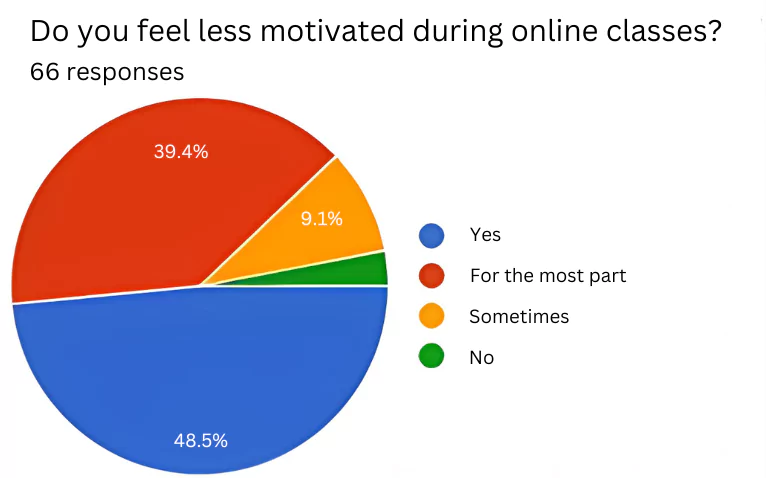
Here’s a pie chart that shows how many students feel less motivated during online classes.
Types of Motivation
Many students begin an online course with strong enthusiasm, but that energy often fades as the term progresses.
Keep your motivation even when things get tough. Here are different types of motivation:

Intrinsic
It comes from within and is driven by personal satisfaction, enjoyment, and interest. For example, it can involve pursuing a hobby, learning a new skill for personal growth, or doing something because it is enjoyable.
Extrinsic
This comes from external factors like recognition, rewards, or consequences. It is not driven by personal interest. Examples include working for a salary, studying for good grades, or performing tasks to avoid punishment.
“Continuous learning is the minimum requirement for success in any field.”– Brian Tracy.
Common Online Learning Challenges
Staying on track in a virtual environment means recognizing friction points before they affect your grades and avoiding failure in your online classes. Below is a breakdown of the friction points online students most often face, and the root causes behind them. The eight strategies that follow address each one directly.
1. Structural & Time Management Challenges
Although flexible hours provide a certain degree of freedom, without strict self-imposed rules, they lead to delay.
Delaying Assignments with Flexible Deadlines
Root Cause: The lack of fixed physical class times and rigid attendance checks creates a false sense of having infinite time.
Task Paralysis from Heavy Workloads
Root Cause: You may feel overwhelmed with huge term projects or multi-chapter readings as a single task.
2. Physical & Environmental Challenges
The immediate study environment dictates the level of concentration, energy, and overall productivity. Therefore, check out the tips to create the perfect study environment.
Overlapping Personal and Academic Boundaries
Root Cause: Studying in bed or in high-traffic household areas that you generally associate with relaxation or socializing can leave you feeling low on energy.
Digital Fatigue & Attention Drift
Root Cause: Continuous staring at screens combined with endless browser tabs and smartphone notifications.
3. Social & Psychological Challenges
Distance learning can often lead to feelings of isolation and comes with psychological barriers that need to be overcome in addition to regular hurdles.
Isolation & Academic Disconnection
Root Cause: Absence of physical classroom interaction, leading to feelings of detachment from peers and instructors. Read the 7 mental health tips for students to avoid this feeling.
Mid-Semester Motivation Drop
Root Cause: Disconnect between tedious daily assignments and long-term academic or career goals.
How to Stay Motivated in Online Classes
Online courses suit students balancing work and family responsibilities. Here, we’ll discuss 8 strategies you can adopt to stay motivated, manage your coursework, and make progress.
1. The Rule of 52/17 (Focus Cycle Method)
Set up a structured schedule to keep track of your coursework. While the main benefit of online learning is flexibility, mastering time management in online classes is essential to manage your academic workload effectively by matching your natural energy cycles.
- 52/17 Focus Cycles: Work in 52-minute blocks of focused, intense study on a single course module, followed by a mandatory 17-minute screen-free break.
- Digital Calendars & Color-Coding: Plan out assignment deadlines, live lectures, and study blocks using Google Calendar or Outlook, color-coding each type of task to quickly gauge daily workloads. Set custom push notifications 24 hours before each due date.
- The 25/5 Pomodoro Sprint: Study in 25-minute bursts on a single task, followed by a mandatory 5-minute screen-free break.
- Weekly Sync: Spend 10 minutes every Sunday evening reviewing your course syllabus and syncing new assignment dates with your primary calendar.
2. The Single-Purpose Study Zone & Digital Environment Audit
Studying from home is easy, but working from your bed or couch is counterproductive and affects your brain’s ability to distinguish between a resting place and a working place.
- 60-Second Digital & Physical Audit (Complete Before Logging In):
- Noise Assessment: Are you limiting background noise? (Put on noise-canceling headphones or open up a brown noise tab.)
- Lighting Check: Is your workspace well lit? (Get near a natural light source or open up a warm light.)
- Tab Overload Sweep: Are you free of other distracting tabs? (Open up a new browser profile for “school” and close all social media, news, and streaming tabs, or do as above.)
- Physical & Posture Setup: Use a clean desk (for school only) along with a laptop stand to free up your eyes from staring at the screen for 8+ hours.
- Sensory Controls: Make sure you limit other distractions by opening up a focus playlist or noise-canceling headphones while doing heavy reading, and sitting near a natural light source.
- Dedicated Browser Profiles: Open up a browser profile for school with social media tabs hidden and your work extensions open.
3. The 5-Minute Momentum Rule & Buffer Method
When you have online classes with flexible or open deadlines, it may be too easy to procrastinate or lock yourself into task paralysis concerning massive assignments.
- The 5-Minute Entry Threshold: Tell yourself that you only need to do a challenging task for five minutes. By clearing the entry barrier, you should find yourself driven to continue, sometimes working on the assignment for hours instead of minutes.
- Task Chunking: Break down your term papers or projects into 3-4 manageable tasks (e.g., topic research, thesis outline, rough draft, and proofreading) using handy apps like Todoist or Google Tasks.
- The 3-Day Buffer: Always aim to finish your work three days before the deadline to give yourself a chance to revise or rewrite in case of technical errors.
4. The Feynman Mastery Technique
Rather than sitting and re-reading a chapter or section, which can be a demotivating and ineffective use of your time, here is a neat strategy for mastering the most challenging concepts in your courses rapidly and tackling 9 challenges of online classes for students.
- Targeted Explanation: Pick a concept or formula that has always been challenging to you from the section or chapter you are studying. Then, attempt to write down or say out loud what you understand by it, as if you are teaching an 8-year-old.
- Gap Analysis: Note the precise parts that you struggled to explain in simple terms.
- Targeted Review: Go back to your notes or textbook chapter and review the exact concepts that you found challenging. Alternatively, you can also contact a qualified tutor from a reputed academic mentoring company to fill these knowledge gaps.
5. The Digital Off-Switch Protocol
Student burnout is one of the most critical common mistakes to avoid in online class setups, which is why it’s so important to enforce a firm division between schoolwork and relaxation time.
- Designated “Off-Hours”: Set a hard cutoff time for yourself each evening (say, 8:00 PM) w