

Table of Contents
ToggleBetween attending classes, submitting assignments, participating in discussion posts in college, and maintaining our social or professional lives, we usually get overwhelmed when exams knock on the door. In retrospect, this happens mainly because we often do not take proper notes in online education. After all, everything is literally at our fingertips!
However, taking notes in online learning not only helps keep things organized but also improves retention. So, what should you do? Before you take out your notebook and start taking notes, you should know the effective note taking techniques for online lectures.
So, get ready because OnlineClassHelp.us.com is here with a banger. This blog includes:
- Why is it important?
- Best note-taking methods for students;
- Tips to improve your notes; and
- Common mistakes you should avoid.
Let’s begin!
Why Is Note-taking Important for Online Lectures?
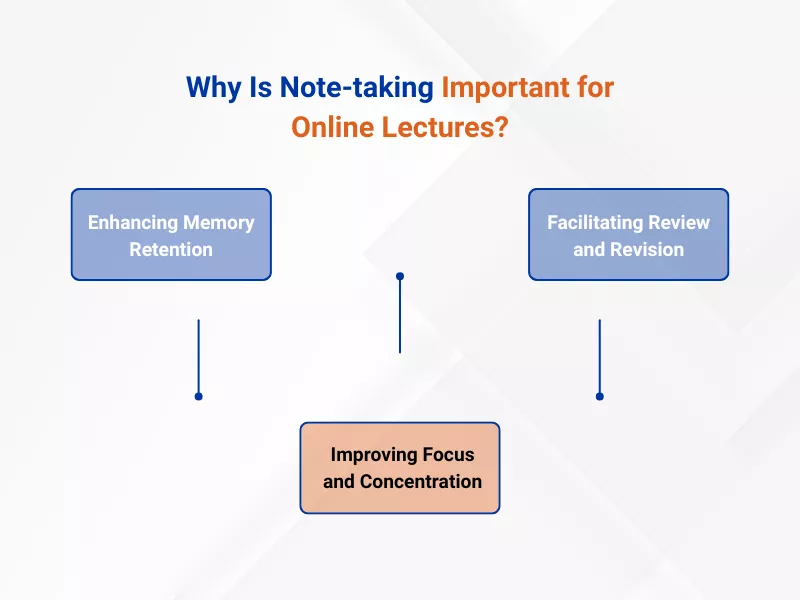
Enhancing Memory Retention
When you take a class and start jotting down notes or information related to your classes or topics, you strengthen your brain’s encoding process. Furthermore, writing notes forces your brain to engage in active listening, which keeps your brain active. So next time you need online course help maybe take a look at your notebook!
Facilitating Review and Revision
During exams, you can simply review your notes and brush up on information without having to engage in studies for hours. Also, does your mind play a situation related to something every time you think of that something? If so, then your brain will help you remember everything taught in class, key points discussed, and organize information relatively faster if you use the right note-taking techniques.
Improving Focus and Concentration
There’s no doubt that students in online classes face many distractions; a single notification can mess up the entire day’s progress. However, when you focus on writing notes, your brain stays engaged in class and keeps you learning. Therefore, it also serves as one of the best Memorization Techniques for Students!
Now that you know the importance of note-taking, let’s move to the different methods you can use to take notes in online lectures.
Different Note-Taking Methods for Online Learning [With Digital Note-Taking Tools for Online Learning]
Thinking of the Top 5 Study Techniques? Effective note-taking strategies are definitely one of them!
Here are some powerful methods you can try—each works best for different subjects and learning styles.
| Note-Taking Method | Pros | Cons | Key Features | Best For Students | Recommended Digital Tools |
| Boxing Method | – Groups related ideas visually – Easy to scan and review – Highlights categories | – Can take longer to set up – Less linear for sequential topics | – Uses boxes to organize concepts – Visual layout for clarity | Visual learners, students studying topics with clear categories (psychology, marketing) | Google Keep, Evernote |
| Outline Method | – Organizes information hierarchically – Easy to review key points – Supports structured thinking | – May miss details if lecture moves quickly – Can become cluttered | – Headings, subheadings, and bullet points – Linear structure for logical flow | Students who like structured notes, subjects with sequential content (history, biology) | OneNote, Notion, GoodNotes |
| Charting Method | – Excellent for comparisons – Efficient for organizing facts – Quick visual reference | – Takes time to set up charts – Less flexible for unstructured lectures | – Rows and columns to compare concepts – Good for data-heavy subjects | Analytical learners, subjects with comparisons (chemistry, economics, political science) | OneNote, Notion, Excel / Google Sheets |
| Mapping Method | – Shows connections visually – Encourages big-picture thinking – Supports brainstorming | – Can be messy – Not ideal for linear content | – Diagrams, branches, and relationships – Mind-mapping style | Visual learners, brainstorming, complex subjects | OneNote, Notion, GoodNotes, Obsidian |
| Sentence Method | – Captures everything – Works well for fast-paced lectures – Simple to use | – Can become long and unorganized – Harder to review | – Each idea written as a separate sentence – Sequential capturing of content | Fast-paced lectures, auditory learners, detailed note-takers | Google Keep, Evernote, OneNote |
| Zettelkasten Method | – Encourages deep understanding – Links ideas across topics – Supports long-term learning | – Requires consistent effort – Can be time-consuming | – Notes as individual “cards” – Bidirectional linking – Knowledge network creation | Research-focused students, writers, long-term projects | Obsidian, Notion |
| Cornell Note-Taking Method | – Promotes active recall – Easy to review and self-test – Structured approach | – Needs initial training – Takes more prep time | – Divided page: Notes, Cues, Summary – Encourages summarization and questioning | Students who like structured learning, exam preparation, self-testing | OneNote, GoodNotes, Anki, Quizlet |

Boxing Method
One of the best note taking techniques for virtual classes is the boxing method. Here, you can group information into visual boxes related to your theme, topic, or subject. Just as there are multiple Benefits Of Online Classes, this popular note-taking method benefits you by compartmentalizing ideas and making notes easier to scan.
So, if you are a visual learner, this visual note-taking strategy can do wonders for you when taking lectures for subjects like psychology, business, or digital media. Furthermore, if you add Google Keep or Evernote to this, then you can fill in all the gaps in your understanding without losing your hair.
Outline Method
One of the most awesome note taking strategies, the outline method. You can structure notes in hierarchies using headings, subheadings, and bullet points. You can add note-taking apps like OneNote, Notion, and GoodNotes for logical, linear content such as history or biology. This is one of the best ways to organize your notes for lectures or meetings without skipping a beat! By taking notes in this manner also increase the chances of getting good grades in college.
Charting Method
Charting method is another effective note-taking method. The charting method is ideal for courses like chemistry, economics, and political science for organizing information into rows and columns. Now, whether you take notes by hand or digitally, you can retain information to compare and contrast main ideas and concepts (e.g., theories, events, processes) by using this method.
Mapping Method
Did you know that mind-mapping handwritten notes or digital notes can actually boost your mental health as well? How? Well, the mapping method is a visual method that uses diagrams, branches, and connections to make your notes appealing and easy to read. Great for brainstorming, complex topics, or visual learners, you can pair it with OneNote, Notion, GoodNotes, and Obsidian. And this was one of the Mental Health Tips for Students, beyond the typical ones!
Sentence Method
One of the best tips for note taking during online lectures, the Sentence Method, involves writing down each new idea, fact, or concept as a separate sentence. This method is especially effective when typing notes on a computer in fast-paced online lectures where information comes quickly.
Zettelkasten Method
The zettelkasten method is a personal knowledge-building system that uses “slips” or cards for each idea. This encourages linking ideas across topics to build deep understanding. Useful for long-term projects, research, or subjects requiring synthesis.
Cornell Note-Taking Method
If you wish to improve your note-taking skills, divide a page into three sections: Notes, Cues, and Summary. Encourages active learning through questioning and summarizing. Very effective for studying, reviewing, and self-testing.
Now that you know effective note taking techniques for online lectures, let’s understand what guidelines you should follow to have well-organized notes.
Note Taking Guidelines [10 Tips for Effective Note-Taking]

Now that you know the methods, let’s check out the best practices for note taking in virtual lectures:
- Incorporate Visuals: Use diagrams, arrows, color-coding, charts, or highlighting to emphasize relationships and make notes more memorable.
- Review within 24 Hours: A quick initial review strengthens memory and lets you fill in gaps while the material is still fresh.
- Use a Structured Format: Choose a note-taking system that suits your learning style, such as Cornell notes, the outline method, or mind maps. A consistent structure improves organization and recall.
- Summarize Each Section: At the end of a topic or page, write a 1–2 sentence summary capturing the essence. This helps reinforce your understanding.
- Keep Notes Clean and Minimal: Avoid clutter. Leave a blank space for adding details later. A clean layout improves focus and reduces cognitive load.
- Write Questions in the Margins: Turn facts into questions. This technique deepens understanding and creates natural prompts for active recall.
- Use Abbreviations and Symbols: Save time by creating a personal shorthand system (e.g., “w/” for “with,” “↑” for “increase,” “→” for “leads to”).
- Use Headings, Bullets, and Spacing: Break your notes into sections. This makes them more readable and helps you quickly find information later.
- Focus on Key Ideas, Not Every Word: Listen or read for main points, definitions, examples, and conclusions. Summarize in your own words instead of copying verbatim.
- Connect New Information to Previous Knowledge: Add cross-references, examples, or links to earlier notes. Making connections strengthens long-term retention.
How to Determine What’s Important Enough to Write Down?
Now that you have all online learning success strategies, let’s discuss how you can determine what notes you should write down:
Trust Patterns, Not Panic
If you try to write everything, you’ll drown. Instead:

The more you practice, the faster you’ll sense what matters.
Look for Signals of Importance
Remember your previous lectures? Now listen to them again. Your instructor must have dropped hints at key points. Write things down when you notice:

Capture Main Ideas, Not Details
Note-taking isn’t easy, while revisiting your notes helps you a lot, but you need to learn to focus on the big picture:

Skip minor examples, side stories, or overly specific numbers unless they serve a clear purpose.
Identify Definitions and Core Terms
Write down:

These are foundational and often show up in tests and applications.
Listen for Examples That Clarify Confusing Concepts
One of the most important tips for organizing study notes is to know the art of skipping. Skip most examples, except when:
- The concept is hard to understand without it
- The example is repeatedly referenced
- It’s used as the main explanation
Now that you know the strategies for better note taking in online courses, let’s check out the common mistakes that cost you time and effort!
Common Mistakes to Avoid When Taking Notes in College

Not Personalizing Notes
Every online lecture is recorded. Not adding your own insights, examples, or connections makes them less valuable. Most students make the mistake of copying notes verbatim from slides or textbooks, without adding anything to facilitate later recall and understanding.
Ignoring Lecture Pace and Pauses
Lecture notes can help, but when you try to keep up at all costs, you tend to miss the importance of processing time, which is not pausing to think or summarize during class, leading to superficial notes.
Failing to Track Sources or References
Note-taking may seem simple, but if you miss a source, you will not be able to cite it later. Not noting where an idea came from—lecture, textbook, or article—can make later assignments or research much harder.
Writing Notes in a Single, Unchangeable Format
Using only one rigid format (e.g., always bullet points) for every subject can hinder comprehension. Different ideas or topics may benefit from charts, maps, or sentences, depending on the content.
Relying Solely on Digital Tools Without Pen and Paper
While apps and online tools are great, studies show that handwriting notes strengthens memory and understanding more than typing alone. Over-reliance on digital tools can reduce retention.
So, how to take notes for online classes in an ideal way? Let’s learn that:
How to Take Good Notes for Online Classes: 5 Easy Steps
Step 1: Prepare – Review readings and have materials ready.
Step 2: Pick a Method – Outline, Mapping, Boxing, or Sentence method.
Step 3: Focus on Key Ideas – Summarize main points, definitions, and examples.
Step 4: Use Visuals & Shortcuts – Diagrams, charts, arrows, and abbreviations.
Step 5: Review Quickly – Revise after class, fill gaps, and add questions for self-testing.
Conclusion: Good Note-taking is an Art!
We hope you now realize note-taking isn’t just a task, it’s an art. Therefore, use these note-taking tips and maximize your efforts. Our comprehensive guide will not only help you write a set of notes but also ensure that when you check out the notes from previous lectures, you can quickly recall information.
Frequently Asked Questions
How Do I Organize Notes from Online Classes?
Start with the topic at the top and divide the information into sections. Use headings, bullets, or digital tools to create a set of notes. Digital tools like OneNote, Notion, or Google Docs allow tagging, color-coding, and hyperlinks for easy retrieval. Summaries and review questions at the end of each section boost clarity and retention.
How Can I Take Effective Notes in an Online Class?
Focus on key concepts, definitions, and examples instead of writing everything in the note section. Use a structured method (Outline, Mapping, or Cornell), incorporate visuals, and type or write in your own words. Review notes later (no less than 24 hours) and refine them to reinforce learning.
How Do I Stay Focused and Take Notes in Virtual Lectures?
Eliminate distractions by silencing notifications and closing unrelated tabs. Engage actively by writing a summary, asking questions, and using visuals or shorthand. Short breaks during long lectures help maintain concentration and prevent mental fatigue.
What Is the Best Way to Take Notes during Online Lectures?
Choose methods like the Cornell University method (aka Cornell Method) or mapping. This method organizes information into structured sections, making review faster and more effective.
How Do I Capture Important Points in Fast-paced Online Lectures?
Use shorthand and bullet points during the lecture; notes can also include key examples or diagrams. Reviewing them afterward can help you make a clear, organized summary of the main points.
How Does the Digital Notes by Cornell Method Help Online Education?
The Cornell method structures notes into cues, notes, and summary sections. This approach help you make connections between ideas, retain key concepts, and review efficiently for exams or assignments.